The Zilarent Blog
How Much Does Turo Take From Hosts? The Real Math
Ask five Turo hosts what the platform takes and you will hear five different numbers, most of them right. Each host is on a different plan, some host where lead time changes the split, and some count delivery and reimbursements while others leave them out.
Host share figures are current as of October 2, 2026, sourced from Turo's help center and linked where they appear. Turo changed the rules in March 2026, so check the linked pages before you act.
The Three Turo Host Earnings Plans
Each Turo earnings plan sets your host share, which Turo defines as a percentage of the trip price, and your damage responsibility, which is what you pay per incident before Turo reimburses eligible physical damage (Turo: Earnings plans in brief, US hosts). The higher your share, the more of each damage claim you carry yourself.
| Earnings plan | Host share of trip price | Turo keeps | Damage responsibility per incident | Third-party liability coverage |
|---|---|---|---|---|
| More Peace of Mind | 70% | 30% | $250 | Up to $750,000 |
| Balanced | 80% | 20% | $1,500 | Up to $750,000 |
| More Earnings | 90% | 10% | $2,750 | Up to $750,000 |
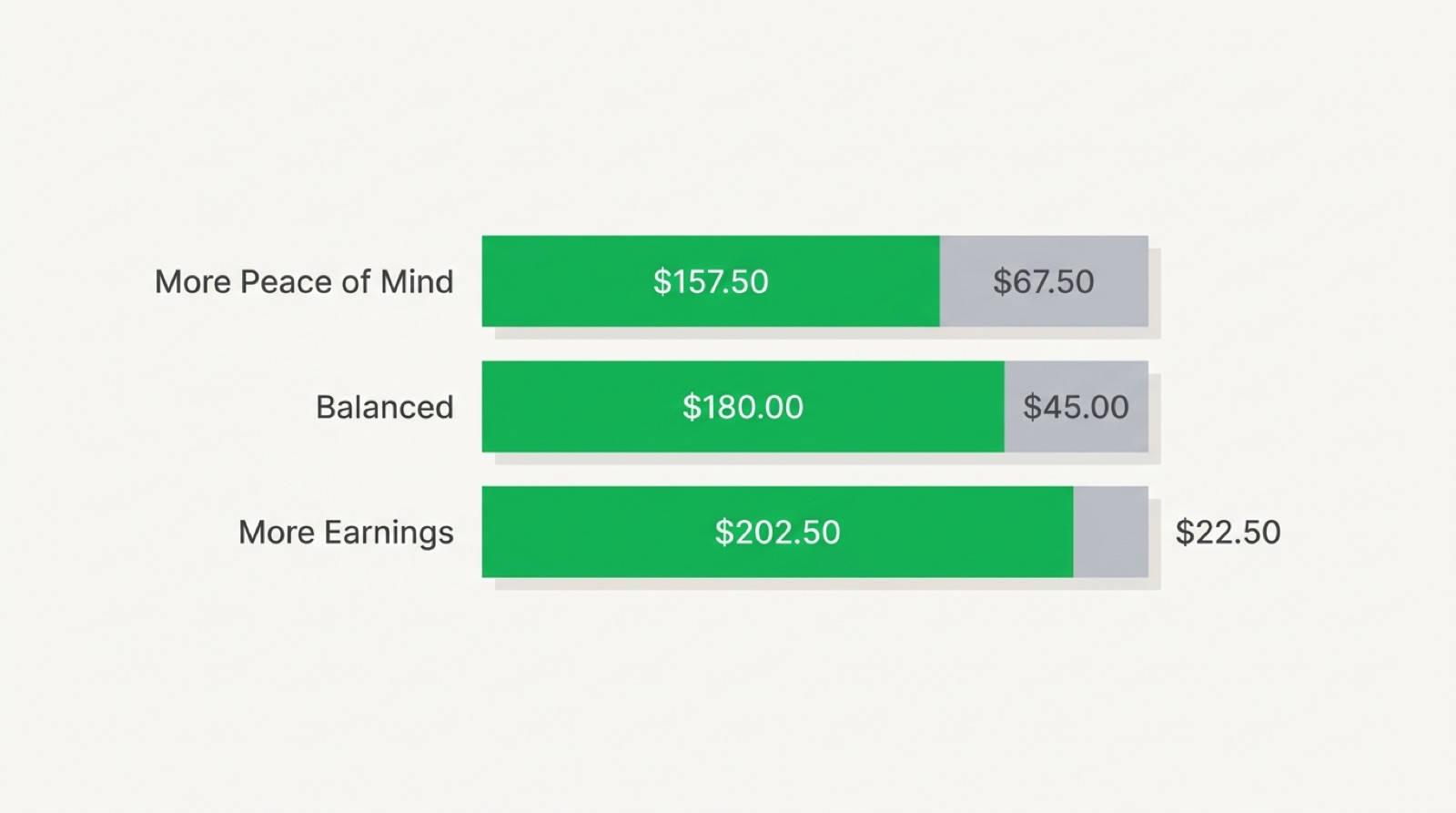
New York limits differ. Here is how much Turo takes from hosts in dollars on one trip: a $75-a-day car on a three-day trip is a $225 trip price. You keep $157.50 on More Peace of Mind, $180 on Balanced and $202.50 on More Earnings, and Turo keeps $67.50, $45 or $22.50.
For a fleet, the useful detail is that you can choose a different plan for each car and change plans at any time; changes apply to new bookings only (same source). A new, high-value car can sit on More Peace of Mind while older paid-off cars run on More Earnings.
The price of a higher share is risk. Moving a car from Balanced to More Earnings adds 10 points of trip price to your payout and $1,250 to your exposure on every incident. On a car with $1,000 a month in trip price, those 10 points are worth $1,200 a year, less than the extra exposure from a single claim.
What the Percentage Does Not Cover
Turo's host share applies to the trip price. Several other charges pay out at their own rates, the same on every plan (Turo: Earnings and host share):
- Reimbursements: 100% of approved reimbursements for on-trip charging, post-trip recharging, refueling, tickets and tolls.
- Cleaning and smoking fees: 100% of approved fees.
- Delivery: 90% of the delivery price.
- Extras: 90% of the cost of Extras.
The New Variable Host Share in Nine Markets
Since March 31, 2026, Turo applies a variable host share in Austin, Dallas, Detroit, Las Vegas, Maui, Philadelphia, Phoenix, San Diego and Seattle. In these markets your share depends on your earnings plan and on how many days ahead the guest books, with higher shares for earlier bookings. It covers the trip price plus any additional distance, additional usage and late return fees (Turo: Earnings and host share).
| Days booked in advance | More Peace of Mind | Balanced | More Earnings |
|---|---|---|---|
| 28 days or more | 80% | 90% | 100% |
| 14 to 27 days | 75% | 85% | 95% |
| 3 to 13 days | 70% | 80% | 90% |
| 0 to 2 days | 65% | 75% | 85% |
A More Earnings host in Las Vegas keeps the full trip price on a booking made a month out and 85 percent on one made the day before. The share locks at booking: later changes, vehicle swaps and agent-assisted rebookings keep the original share. Everywhere else in the US, the flat plan percentages apply today.
Where Hosts Get the Number Wrong
Most arguments about the Turo commission come from three mix-ups.
First, the percentage is of the trip price you set. Delivery, Extras and reimbursements follow their own rates.
Second, the share depends on the plan and, in nine markets, on lead time. A host quoting 90 percent and a host quoting 70 percent can both be reporting their own payout correctly.
Third, host share is a payout rate, and take-home is what is left after costs. Reimbursements repay fuel, tolls and tickets you already covered, and your damage responsibility comes out of your pocket when a claim lands.
Your real rate is your monthly payout divided by your monthly trip price, measured over a stretch that includes at least one claim.
What Turo Takes vs. a Direct Booking Channel: Run Your Own Numbers
The calculator compares a month on your Turo plan with the same bookings taken direct on a Zilarent booking site. Zilarent costs $299 a month plus a 6% booking fee on everything the renter pays (rate, extras and delivery), including bookings you enter by hand from a phone call. Above $1M a year in Zilarent bookings, the monthly fee is waived and the rate drops to 5%; Turo bookings do not count toward that threshold. Full terms are on Zilarent's pricing page.
You can add a booking fee for the renter at checkout, the way Turo, Avis and Budget show fees, for $0 per booking out of your pocket. That holds when your fee is 6.4% or more: Zilarent's 6% applies to everything the renter pays, your fee included, so 6.4% is the break-even point. Or absorb the 6%.
The defaults are sample inputs, not a forecast: $75 a day, three-day trips and 40 trips a month (about four or five cars) make $9,000 in gross bookings. On Balanced, Turo pays you $7,200. Direct with the fee absorbed, you keep $9,000 minus $540 (6%) minus $299, which is $8,161. Charge the renter a 6.4% booking fee, the break-even point, and you keep $8,702. At one car and 10 trips, the $299 monthly fee takes most of the difference, which is why most operators run 10 or more cars.
The $299 is per business, not per car, so volume changes the picture. At 50 trips a month on the same inputs, Turo pays $9,000 and direct pays $10,276 with the fee absorbed.
Turo also brings the demand, and a direct channel finds its own customers, with a car rental reservation system taking their bookings. In California and some other states, advertised rental prices must include mandatory fees, so check your state's rules before you add a renter fee (California Attorney General: SB 478).
When the Cut Becomes a Business Decision
Three signals say Turo's cut has become a business decision: utilization you can forecast month to month, a Turo cut that ranks among your larger monthly costs in dollars, and demand you can reach yourself through your own website, Google and local search, referrals, and hotels and other local partners.
A direct channel runs alongside Turo, with one firm rule: Turo customers stay Turo customers. Turo's terms ban completing a Turo-found booking off the platform, at $5,500 per breach, and soliciting Turo users to competing sites (Turo: Terms of service). Your direct business grows from customers you find outside Turo and the repeat direct customers they become. Two-way calendar sync keeps a car listed in both places from double-booking. Our guide on when to take your fleet private has the full framework, and car rental software for independent fleets covers the tools. If the fleet is growing, read about running a larger Turo fleet without the burnout and what it actually takes to be a Turo Power Host.
When you are ready, Zilarent offers a done-for-you transition off Turo. Or book a demo and bring your calculator numbers.
Common Questions
What percentage does Turo take from hosts?
Turo keeps 30, 20 or 10 percent of the trip price in most US markets, depending on whether the host picks the More Peace of Mind, Balanced or More Earnings plan. Nine markets also adjust the split by lead time.
Is the Turo commission the same in every city?
The Turo commission follows your earnings plan everywhere in the US. Since March 31, 2026, Austin, Dallas, Detroit, Las Vegas, Maui, Philadelphia, Phoenix, San Diego and Seattle also vary it by how far ahead the guest books.
Does Turo take a cut of delivery and Extras?
Yes. Hosts receive 90 percent of delivery and Extras on every plan. Approved reimbursements for fuel, charging, tolls and tickets pay 100 percent, as do approved cleaning and smoking fees.
Can I change my Turo earnings plan?
Yes. Turo lets hosts change plans at any time and choose a different plan for each car. The change applies to new bookings only, so pending, booked and in-progress trips keep their original plan.
What does a direct booking channel cost on Zilarent?
Zilarent costs $299 a month plus a 6% booking fee on everything the renter pays, with a one-time setup fee quoted on your demo call. A renter booking fee of 6.4% or more covers the 6%, or you can absorb it.
Can I keep Turo while I take direct bookings?
Yes. Two-way Turo calendar sync keeps a car listed on both channels from double-booking. Turo customers stay on Turo, and your direct bookings come from customers you find yourself through your website, Google, referrals and local partners.
Keep more of every booking.
Bring your Turo payouts to a demo and we will walk through your own numbers with you. Turo hosts go live in 5 to 7 business days, with Turo still running.
No commitment. We’ll reach out within 24 hours.